



Photo: QNA
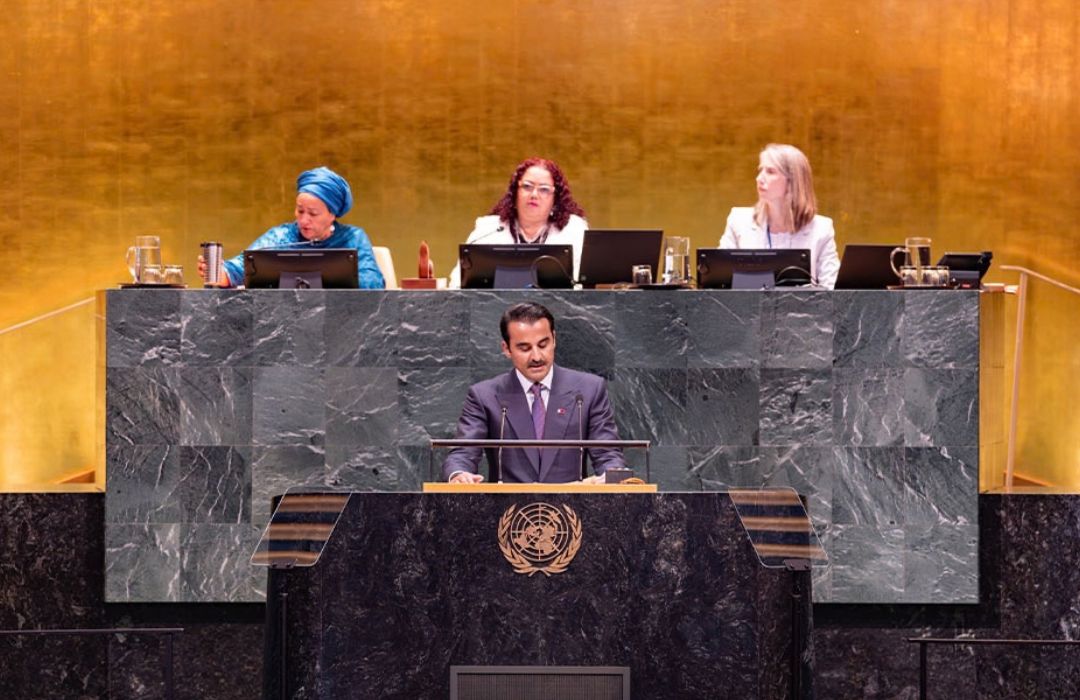
HH the Amir Sheikh Tamim bin Hamad Al-Thani participated in the opening session of the 81st United Nations General Assembly, held on Tuesday morning in New York.
The session was attended by Their Majesties, Highnesses, and Excellencies heads
of state and government, delegations, and representatives of governmental and
civil society organizations.
HH the Amir delivered a speech during the session. The following is an
unofficial translation of the address:
In the Name of God, the Most Gracious, the Most Merciful
Your Excellency the President of the General Assembly,
Your Excellency the Secretary-General,
Honorable Audience,
May the peace, mercy and blessings of God be upon you,
I extend my congratulations to H.E. Mr. Khalilur Rahman on his assumption of
the Presidency of this session, and wish him every success. I also thank H.E.
Ms. Annalena Baerbock for her efforts in presiding over the work of the
previous session.
I would also like to commend the efforts and endeavors of H.E. Mr. António
Guterres, the Secretary-General, throughout his term of office, and to express
our appreciation to the staff of the United Nations organization for their
efforts amid difficult and complex circumstances.
I stand before you today at a time when our region is going through one of its
most dangerous phases, and you are all aware of the dimensions of the crisis in
the Gulf and its repercussions for the entire world.
The crisis we are currently facing should come as no surprise to anyone. It is
the cumulative result of years of postponement, crisis management through
temporary solutions, and unrealistic policies. Our perspective has always been
that the way to resolve disputes is through dialogue and negotiations, leading
to fair solutions grounded in international law and in respect for the
sovereignty of states and the rights of peoples. This remains our position in
the aftermath of the wars we have witnessed.
The State of Qatar, through its role as a trusted mediator and peace
facilitator, has consistently warned that time does not resolve lingering
conflicts in the absence of a just settlement; rather, it redoubles their
costs.
Honorable Audience,
At the heart of the dangerous situation, we are witnessing lies the absence of
a regional system of collective security - one that respects the sovereignty,
security and territorial integrity of states, promotes the peaceful settlement
of disputes, and non-interference in the internal affairs of states.
We have previously called - from this very podium - for the establishment of
such a system, and we reiterate that call after recent events have demonstrated
the urgent need for it. In its absence, it has become possible for a war to
erupt on the basis of considerations unrelated to the interests of the
countries of the region; and it has become possible for one party to drag its
neighbors into a war that is not theirs, targeting their vital assets and
installations despite their strenuous efforts to avert escalation; and for an
international waterway - through which nearly a quarter of the world’s energy
trade passes - to be closed.
It has also become possible for the lifelines of the global economy to be
turned into instruments of pressure and bargaining, with people on every
continent bearing the cost, despite being far removed from the causes of the
conflict.
This is a crisis that drives up the prices of food and medicine and affects the
livelihoods of peoples who have nothing to do with any of this.
Despite all that has happened, and could have been avoided, we remain deeply
convinced, based on realistic considerations, that the crisis in the Gulf can
be resolved through diplomatic means by reopening the Strait of Hormuz to maritime
navigation and returning to negotiations, in order to avert war, paving the way
toward a lasting solution that ensures security and stability for the entire
region, including Iran, while opening prospects for cooperation across various
fields and ensuring non-interference in the internal affairs of states.
The opportunity for a peaceful diplomatic solution, which we believe is both
possible and realistic, must not be missed.
Honorable Audience,
While we are doing everything within our power to address the situation through
diplomatic efforts, we have strengthened our steadfastness in defense of our
sovereignty, our territory and our people, and the foundations of our normal
way of life. We have devised resilient economic plans and remained committed to
our development projects, despite the severe adverse impact of the war and the
heavy price it has exacted.
At every juncture and in every crisis, we have chosen to combine steadfastness
with flexibility, and to place the interests of our nation, its people, and
those residing on its soil above all else.
Our values are not mere slogans we proclaim, but a reality we live by and an
approach we put into practice. At their core is the conviction that the dignity
of the nation cannot be compromised, and that wisdom and firmness are two sides
of the same coin.
This approach was firmly established in our country by the leaders of Qatar,
from the Founder, Sheik Jassim bin Mohammed bin Thani, through to His Highness
Sheik Hamad bin Khalifa Al-Thani, may Allah have mercy on his soul, our Amir
from 1995 to 2013, who passed away this year, mourned with profound affection
and gratitude by his people and by all peace-loving forces across our region
and around the world.
On this occasion, I would like to thank the United Nations General Assembly for convening a special session in honor of his memory and in recognition of his legacy.
The experiences and challenges we have confronted have demonstrated that resilience is the outcome of prior planning, preparedness and investment in people and national capabilities. Accordingly, over the years, we have worked to assess risks, secure supply chains, strengthen the capabilities of our national institutions, develop strategic reserves, and forge trusted international partnerships.
Recognizing the interdependence of peace, security, development, human rights
and the rule of law, the State of Qatar maintains its investment in
development, education, health, security and economic diversification, in
conformity with the Qatar National Vision 2030.
Honorable Audience,
There can be no talk of a just international order so long as Palestine remains
a blind spot within it. What has happened in Gaza is genocide in every sense of
the word, and a stain of shame on the conscience of humanity as a whole. Future
generations will be astonished by the enormous gap between the scale of the
catastrophe and the level of the international response to stop it.
Yet the catastrophe continues, and Israeli leaders have now begun to openly
proclaim that the most appropriate solution is to displace the population,
which they call "migration."
When the extent of global public revulsion at the practices of the Israeli occupation becomes evident, instead of looking in the mirror, they resort to hurling accusations indiscriminately in all directions - at times invoking accusations of antisemitism, and at others resorting to conspiracy theories and accusing other powers and states of creating their negative image. It's as though there were no means of communication; as though Israeli soldiers had not boasted, through both sound and visuals, of their crimes; and as though images of the crimes against humanity committed in Gaza had not been circulated by an entire generation of young people across the world, east and west.
From the very first day, the State of Qatar has spared no effort in its mediation endeavors to stem the bloodshed, alleviate the suffering of civilians, and release the prisoners and detainees until a ceasefire was achieved. Today, we continue our efforts to consolidate it and to move towards lasting peace.
And if the Palestinian factions tend to agree to arrangements for the collection of weapons, as stipulated in the agreement, Israel, for its part, must fully honor all its commitments and in their entirety: a definitive cessation of operations, withdrawal from the Strip, lifting of the blockade, and the unconditional delivery of humanitarian assistance.
We fear that those who regard displacement as the solution will obstruct anything that could ease the lives of the population, because it strengthens their resilience on their own land.
The international community bears a direct responsibility to press for implementation and to ensure that the agreement's implementation does not remain contingent upon the calculations of a party accustomed to reneging on its commitments whenever circumstances allow it to act with impunity on the ground.
The continued persecution, apartheid and settler terrorism in the occupied West
Bank, the desecration of Islamic and Christian holy sites - foremost among them
the blessed Al-Aqsa Mosque - and the usurpation of the Palestinian people's
rights, foremost among which is their inalienable right to establish their
independent state with East Jerusalem as its capital, remain an open wound.
Israeli aggression, marked by arrogance and hubris, has expanded to encompass
neighboring countries and the security of the region as a whole. Israel
continues its blatant attacks against Syria and is occupying more Syrian
territories and adding them to the Golan Heights, which it has occupied since
1967, without even bothering to provide any justification other than its own
assessment of the nature of the political system that emerged there after the
removal of the previous regime - as though it owns tutelage over the countries
of the region.
It publicly declares that it is not bound by its understandings with Lebanon, insists on continuing its occupation of Lebanese territories, and seeks to assume a policing role there. Its destruction of entire villages in southern Lebanon in broad daylight is reminiscent of its history in Palestine.
Dealing with Israel, putting an end to its harm, and restraining its unlawful
conduct constitute the true test of the international community's seriousness
in upholding values and the rule of law. Either the law applies equally to all,
or it loses its meaning when it binds the vulnerable but spares the
powerful.
Honorable Audience,
In our Arab region, we reaffirm that comprehensive development and the
establishment of state institutions are two fundamental pillars for realizing
the aspirations of peoples and achieving security and stability in the region.
The vestiges of civil conflicts in some countries and the presence of armed
forces operating outside the control of the state must be eliminated. The
state's monopoly on legitimate arms is among the most important foundations of
the state, and it is what guarantees the ability to legislate and enforce the
rule of law.
Concerning brotherly Syria, we stand with its people during the phase of recovery and reconstruction, and support its state institutions, sovereignty, independence, and national and territorial integrity, in a manner that fulfils the aspirations of the Syrian people for stability, development and dignity, based on equal citizenship.
In brotherly Sudan, we call for an inclusive dialogue that leads to sustainable
peace and maintains its unity and sovereignty. In brotherly Libya, we support
the political process, reconciliation efforts, and the unification of State
institutions.
In brotherly Somalia, we reiterate our firm support for its sovereignty, unity
and territorial integrity.
In brotherly Lebanon, we support its state institutions and its sovereignty over its entire territory, condemn the Israeli attacks on it, and stress the need to uphold the ceasefire and Security Council Resolution 1701.
In brotherly Yemen, we support United Nations efforts aimed at reaching a comprehensive political settlement based on the outcomes of the national dialogue facilitated by the United Nations, in a manner that preserves Yemen's unity and sovereignty and achieves security and stability.
Honorable Audience,
The State of Qatar does not confine itself to playing a mediating role and
facilitating dialogue among conflicting parties in the pursuit of peaceful
solutions. We also make efforts to address the humanitarian suffering of people
caused by wars and natural disasters, while supporting human development in
numerous countries across our region and beyond.
This combination of safeguarding our vital interests, pursuing our proven, valued and internationally recognized role in mediation and humanitarian action, and upholding principled positions consistent with international law and international legitimacy constitutes the foundation of our foreign policy, with these four elements as its essential components.
Qatar will remain an open realm for dialogue and cultural interaction among
peoples, and for the exchange of views and experiences. We continue to
contribute to international initiatives that bring peoples together and support
development.
In this spirit, Doha is preparing to host the Fourth Global Disability Summit
in 2028, reaffirming our commitment to empowering persons with disabilities and
building inclusive societies. Qatar will also host the 2027 FIBA Basketball
World Cup, in recognition of the role of sport in building bridges of
communication and bringing peoples closer together.
The expansion of the United Nations House in Doha marks a continuation of our
longstanding partnership with the international organization and an enhancement
of its capacity to fulfil its mission of serving peace, development and human
rights.
Peaceful coexistence and dialogue are not merely one option among many; they
are the only path that leaves neither a victor nor a vanquished.
For this reason, we renew our commitment to the Charter of the United Nations
and its purposes, and affirm that the State of Qatar will always strive for
peace and facilitate its achievement.
Thank you.
May the peace, mercy and blessings of God be upon you.